OMNIDIMENSION

A Proposed Framework for Multi-Directional Physical Space

Selvinkumar S S

Page 2

Author's Note & Scientific Disclaimer

This illustrated book presents Omnidimension as a proposed conceptual framework. It is not an established law or theory of physics.

Established concepts such as dimensions, vectors, spacetime, waves and fields are identified as such. Any Omnidimension-specific definitions or mathematical expressions are proposals that require rigorous analysis and experimental validation.
Page 3

Abstract

Omnidimension is proposed as a framework for describing physical systems using spatial position, direction, orientation and time in a unified measurement description.

The central idea is complete multidirectional representation. Importantly, 360° is angular coverage, not a new dimension.

Page 4

Introduction

Physics uses coordinates and mathematical models to describe measurable reality. A useful framework should distinguish dimensions from directions and should preserve information that may be lost when observations are reduced to one preferred axis.

This book develops a simple proposed vocabulary for such multidirectional description.

Page 5

What Is a Dimension?

A dimension is an independent coordinate needed to locate an event or state within a model.

One-dimensional space needs one coordinate; a plane needs two; ordinary space needs three.

Page 6

1D, 2D and 3D Space

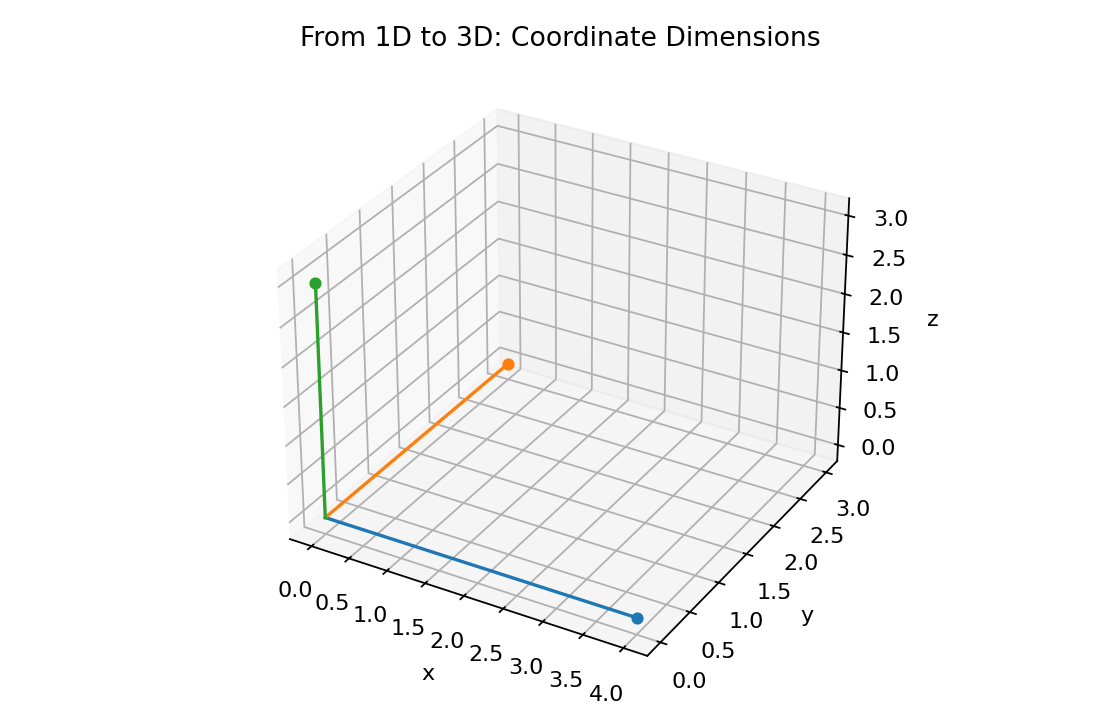
A point in ordinary 3D space can be written as (x, y, z). Adding coordinates increases the number of independent degrees of freedom in the model.

From 1D to 3D: coordinate dimensions.

Page 7

4D Spacetime

Relativity describes events using three spatial coordinates and time. Time is physically different from an ordinary spatial axis, so this book avoids treating '4D' as simply four spatial directions.

Page 8

Higher Dimensions

Some theoretical models use additional dimensions. Their interpretation depends on the theory and evidence. Omnidimension does not assume such dimensions exist; it allows them as optional variables in a mathematical model.

Page 9

Direction vs Dimension

Direction describes orientation in an existing space. Dimension describes the number of independent coordinates. A full 360° rotation therefore does not create an additional dimension.

Page 10

The 360° Spatial Concept

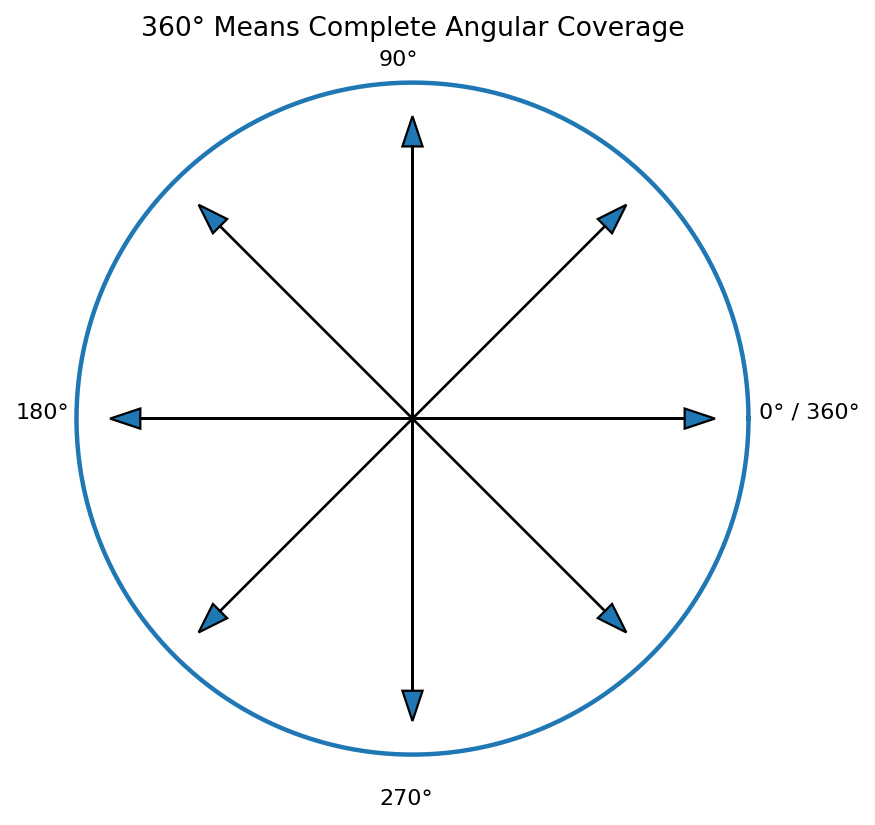
A complete angular scan around an axis covers 360°. In spherical geometry, direction can be represented with angular coordinates. This is useful for sensors, radiation measurements and field mapping.

360° means complete angular coverage.

Page 11

Defining Omnidimension

Proposed definition: Omnidimension is a conceptual framework for representing a physical system across all relevant spatial directions, coordinates, orientations and, where appropriate, temporal or hypothetical additional variables.

The word is used here as a proposed term, not as a claim about an established branch of physics.

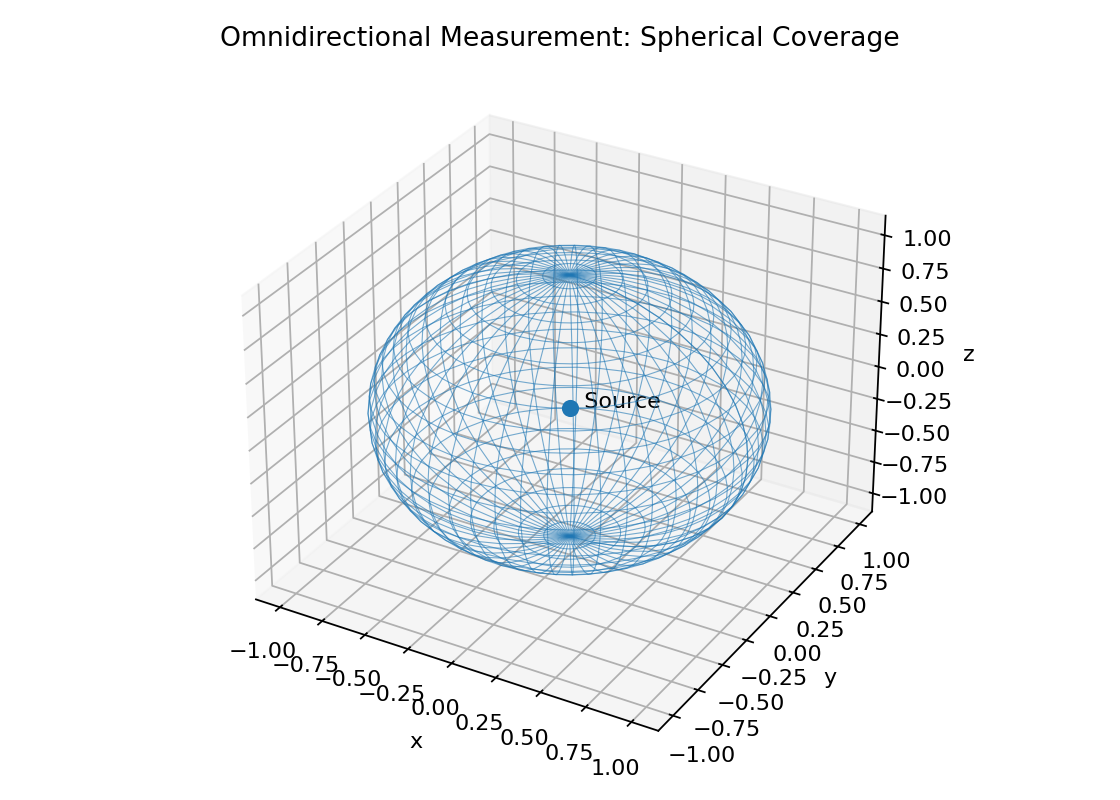
Omnidirectional measurement: spherical coverage.

Page 12

Omnidimensional Coordinate System

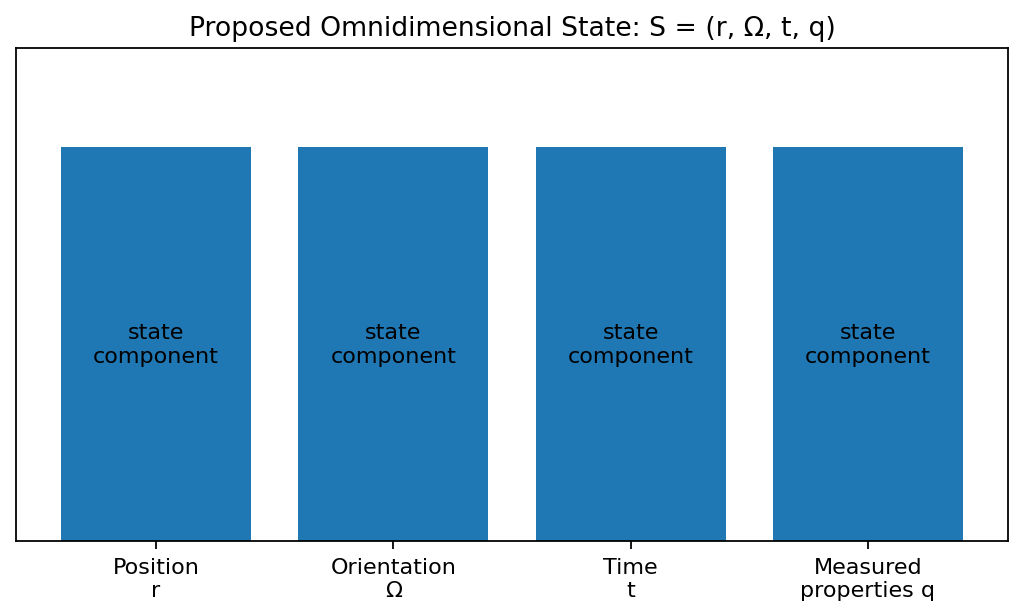
A minimal state description can be represented conceptually as S = (r, Ω, t, q), where r is position, Ω is orientation, t is time and q represents measured physical properties.

Page 13

Position and Distance

Position can be represented using Cartesian, cylindrical or spherical coordinates. Spherical coordinates are especially useful when a system has radial or angular symmetry.

Proposed state components: S = (r, Ω, t, q).

Page 14

Direction and Orientation

A vector represents magnitude and direction. Orientation describes how an object or sensor is rotated.

Combining position and orientation is useful in robotics, aerospace and measurement systems.

Page 15

Motion

A moving object can be represented by r(t). Velocity is the time rate of change of position and acceleration is the time rate of change of velocity.

Page 16

Velocity and Acceleration

Established vector relations are v = dr/dt and a = dv/dt. Omnidimensional analysis simply retains all relevant vector components.

Page 17

Forces

Force is a vector. A net force can be resolved into components. Newton's second law remains F_net = ma within classical mechanics.

Page 18

Gravity

Newtonian gravity and general relativity are established frameworks with different domains and mathematical descriptions. Omnidimension does not replace them; it proposes a multidirectional representation layer.

Page 19

Energy Distribution

Energy density and energy transport can vary throughout space. A complete spatial measurement can reveal gradients, symmetry and directional structure.

Page 20

Waves

Waves can propagate in many directions. Ideal point-source wavefronts in a uniform medium are spherical. The wave relation v = fλ remains an established relation; omnidirectional propagation is a geometry, not a new dimension.

Page 21

Fields

A field assigns physical quantities to positions in space and time. Mapping a field over many directions can reveal anisotropy and preferred orientations.

Page 22

Time

Time may be treated as a parameter or coordinate depending on the theory. A proposed state function can include time while keeping its physical interpretation explicit.

Page 23

Proposed Mathematical Framework

The proposed state S = (r, Ω, t, q) is a bookkeeping model. A measurement function may be written conceptually as M(r, Ω, t). These are proposed definitions, not experimentally verified laws.

Page 24

Example: 360° Sensor Scan

A sensor at a fixed position can record a quantity I(θ, φ) across azimuth and elevation. A full scan attempts to sample the complete angular domain allowed by the instrument.

Page 25

Example: Moving Object

For a trajectory r(t), position, velocity and acceleration can be computed using standard calculus. Adding orientation Ω(t) gives a richer state for a rotating body.

Page 26

Experimental Model

A practical experiment could use a rotating sensor, a calibrated source, accurate timing and position tracking. The proposed framework should be compared directly with conventional coordinate analysis.

Page 27

Sensors & Measurement

Possible instruments include sensor arrays, antenna arrays, microphones, cameras, rotating scanners and distributed measurement networks. Calibration, angular resolution and timing accuracy are essential.

Page 28

Potential Applications

Potential uses include robotics, aerospace sensing, 3D mapping, navigation, environmental monitoring, communication systems and scientific simulation. These are possibilities, not proven advantages.

Page 29

Limitations & Scientific Challenges

A new name does not establish a new physical law. The framework must produce precise definitions, internally consistent mathematics, quantitative predictions and reproducible experimental tests.

A successful theory must also agree with established physics in regimes where established physics has been repeatedly verified.

Page 30

Future Research

Research could investigate coordinate transformations, field reconstruction, sensor fusion, relativistic extensions and mathematical connections to higher-dimensional models.

The strongest next step is to identify one unique, measurable prediction and test it.

Page 31

Conclusion & References

Omnidimension is proposed here as a framework for complete multidirectional physical description. 360° represents complete angular coverage, while dimensionality refers to independent coordinates.

Foundational areas for further study: classical mechanics, vector calculus, spherical coordinates, electromagnetism, wave physics, special relativity and general relativity.